“What time is my appointment?”
“Two o’clock.”
Five minutes later. “What time is my appointment?”
“Two o’clock.”
Three minutes after that. “What time is my appointment?”
And before you can catch it, out it comes. “I already told you. It’s at two.”
Careblazer, if you’ve lived that exact moment, you’re definitely not the only one. Somebody repeating the same question over and over, or telling the same story for the fourth time in an hour, wears on a person. Especially when you’re already tired and already depleted.
Last week I went through six caregiver habits that make dementia behaviors worse. Things we do. That video sparked this one, which is about four phrases to avoid with dementia. Things we say.
If you’ve said all four of them, that doesn’t mean you’re doing something terrible. These are things we would say to absolutely anybody who doesn’t have dementia. They’re normal conversation. That’s exactly what makes them so hard to break.
The 4 Phrases to Avoid With Dementia, and What to Say Instead
Here’s the short version. The rest of this post explains what each one is doing to their brain, and why the replacement works better.
- Instead of “I already told you,” give the answer again, in the same neutral tone you used the first time.
- Instead of “Don’t you remember?” hand them the information. Not “Do you remember Sarah’s coming?” Just “Sarah’s coming today.”
- Instead of “You just asked me that,” answer it again. If it’s a repeated story, listen to it rather than correct it.
- Instead of “Why did you do that?” stop asking them and ask yourself. What happened right before? What could this behavior mean?
“I Already Told You”: Why Reminding Them Doesn’t Help
Back to that appointment.
We say “I already told you” out of frustration, and that part is human. But there’s usually a second thing happening underneath it. Some part of our brain is thinking that if we remind her we already answered, maybe that will help her hold onto it this time.
It won’t. Dementia interferes with the ability to store the information in the first place, so reminding her that you already answered does nothing to restore what was never kept. This is the reminding trap.
What I would do instead is just repeat the information. Very neutrally, without a lot of emotion on it. The same way you would answer if she asked you what color the sky is today. You wouldn’t get frustrated by that question. You would just answer it.
If it’s the same question over and over and it’s becoming a pattern, write the answer down somewhere she can see it. A whiteboard, a piece of paper on the counter, something in her line of sight. Then when she asks, you can say, “Oh, I wrote it right down here for you.”
Here’s the thing I really want you to hold onto. For you, this might be the fifteenth time you’ve heard that question today. For her, it’s question number one. Every single time. So you answer it freshly, and you move on until she asks again. If you want to go deeper on that one behavior, I’ve written about why repeated questions happen and what helps.
“Don’t You Remember?”: Why Testing Their Memory Backfires
This one sounds like help. “Remember, I told you?” “We talked about this yesterday.” “Come on, you remember.”
And we usually do mean it as help. We’re hoping that a little encouragement, a little prompting, will pull the information back out of their brain.
Much of the time in dementia, there’s nothing in there to pull out. The information was never encoded. It never landed. The structures that do that filing work, the entorhinal cortex and the hippocampus, are where Alzheimer’s damage shows up earliest. So the memory isn’t buried somewhere waiting for a better prompt. It was never filed.
Which is why this phrase becomes a problem. We’re no longer simply giving them information. We’re asking them to confront the thing they can’t do. That’s the trap of highlighting their deficits.
Imagine you’re struggling with something. Really struggling. And somebody keeps pointing directly at the thing you’re struggling with. “You don’t remember? Still don’t remember? Come on, remember now?”
That’s what this phrase does, over and over.
So instead of testing whether they have the information, just hand them the information. Not “Do you remember that Sarah’s coming today?” Just, “Sarah’s coming to see us today.”
It’s a small change in the sentence. It’s a very large change in what you’re asking of them. If this idea is new to you, it connects closely to the single most common communication mistake I see in dementia care.
“You Just Asked Me That”: Why Pointing Out the Repetition Won’t Stop It
This one is subtle, and I think it slips past a lot of us.
What we’re really hoping, when we point out that they’re repeating themselves, is that they will notice it and stop. That awareness will do the work for us.
But look at what that requires. For them to realize they just asked you the same question, their brain would have to remember asking it. And the exact brain changes causing the repetition are the same brain changes that keep them from remembering they already asked.
There’s research showing this directly. People in the earliest stages of Alzheimer’s consistently overestimate how well their memory is working in everyday life. The awareness itself is affected, so a comment from you can’t switch it back on. This is the repetition awareness trap.
The same is true for “You already told me that” and “You just told me that.”
And it’s not only questions. They may tell you the same story again and again. With a repeated question, often you can simply provide the information one more time. With a repeated story, there’s something else available to you. That story is an opportunity to connect with them instead of correcting them.
“Why Did You Do That?”: Why They Can’t Explain Their Own Behavior
Maybe your loved one put all of their clothes in a pile by the front door. Maybe your mom emptied every single drawer in the kitchen. Maybe something turned up in a place that makes no sense at all.
Naturally, we’re curious. “Why did you do this? Why are you doing that?”
With anybody else, that’s a completely fair question. But think about everything you just asked their brain to do.
You asked them to remember what they did at some point in the past. You asked them to remember what they were thinking before they started. You asked them to connect those thoughts to the action they took. And then you asked them to put all of that into words and explain it back to you.
Our brains do that chain so easily that we don’t notice it’s a chain. For a person with dementia, those connections have broken down, which is also why they often take so much longer to respond to an ordinary question. That’s a lot to be asking. This is the explanation trap.
The most accurate answer they may be able to give you is “I don’t know.” Or they will give you an explanation that makes no sense to you either, and you’re no closer to understanding why the clothes are by the door.
So here’s what I would do instead, depending on the behavior.
Let the Harmless Behaviors Go
If they’re doing something that makes no sense to you but isn’t hurting anybody and isn’t going to create a big problem for you down the road, we can very often just let them do it.
That strange behavior is holding their attention. It’s keeping them engaged. Which means they’re not doing something disruptive. A lot of the time, we can let them be.
Get Ahead of the Trigger
If it’s something you really don’t want them doing, see if you can remove or replace whatever is setting it off.
Say they keep moving their eyeglasses and the glasses keep ending up somewhere strange. You could keep multiple pairs around the house. You could start tracking where the favorite hiding spots are. You could get in the habit of saying, “Here, I’ll take those,” when they come off, and putting them somewhere safe.
You’re not correcting the behavior. You’re getting ahead of it.
Ask Yourself Why Instead of Asking Them
This is what I call becoming a dementia detective. Take the question you were about to ask them and ask it of yourself.
What were they doing right before the behavior? What was happening around them right before it started? What could this behavior mean? Where else would this behavior make sense? What are the actual steps involved in what they’re doing?
Your loved one can’t walk you through their reasoning. You can often reconstruct it.
What All Four Phrases Have in Common
“I already told you.” “Don’t you remember?” “You just asked me that.” “Why did you do that?”
Every one of them asks their brain to do something it’s no longer able to do.
We’re not being careless when we say these things. We’re speaking to our loved one the way we speak to every other adult in our life, and the rules quietly changed on us.
The same thing sits underneath the bigger habits I wrote about in what not to say to someone with dementia: correcting, reasoning, arguing. Those are the patterns. These four are the sentences that slip out inside them.
Why There Is No Single Right Response to a Dementia Behavior
I want to come back to repeated questions, because I’ve already given you several different answers to the same behavior in this one post.
When your loved one asks the same question over and over, you can simply answer it again. You can point them to the answer written down, the way I described earlier. You can offer reassurance, because sometimes the question is anxiety looking for somewhere to land. You can redirect. You can look underneath the question for the emotion or the unmet need driving it. Or you can head it off entirely by giving them the information before they think to ask.
Six responses. One behavior.
I know how that sounds when you’re tired. “This is too complicated. Can’t you just give me the answer?”
But that’s the point I want you to see. The same behavior in two different people can have two different causes, can mean two completely different things, and can need two completely different responses. What works beautifully for your loved one may do nothing for another Careblazer’s, and that’s not a failure on anybody’s part.
Which is also why caregiving isn’t a recipe where they do X and you do Y. Eventually you’ll have something close to a recipe, but it’ll be very specific to your loved one, and you’re the one who writes it. Nobody else has it. You’ll develop it by testing things. That goes for the communication techniques I teach, too. Try them, and keep what works for your loved one.
So take the pressure off yourself to get it right the first time. As complicated as this sounds, it’s not harder than doing the same thing over and over and getting the same result you don’t want.
Their reaction tells you whether it worked. If it seemed to put them at ease, if the behavior moved on, lean on whatever you just did. If it made things harder, that’s not the approach for your loved one, and you can pivot away from it.
And then the brain changes again. Cells keep dying, so what works now may not work forever, and you’ll be back to experimenting. That’s not you getting something wrong. That’s you adapting to a moving target, which is one of the genuinely hardest things about this disease.
You’re not looking for the universally correct response. You’re looking for what helps this person, in this situation, with the brain they have right now. That’s it.
Careblazer, nobody can hand you this recipe. You write it, one try at a time, for a person you know better than anyone else does. And you’ve already started.
Where to Find More Tools Like These
Four phrases is a start. The situations keep coming, though, and they rarely arrive one at a time.
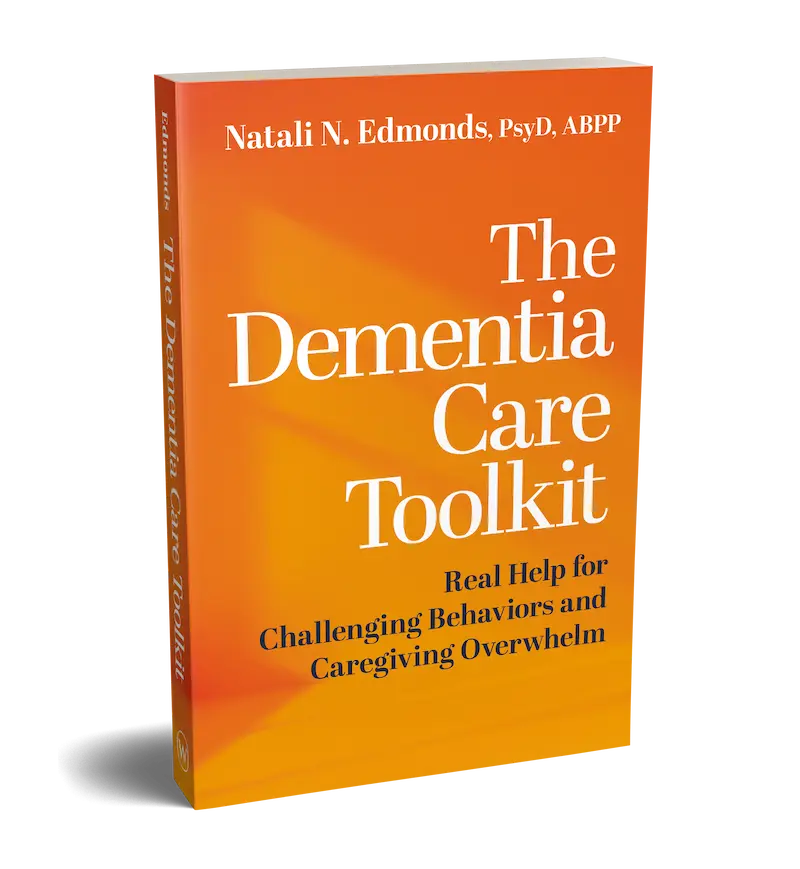
That’s what I built The Dementia Care Toolkit for. You can open it to a page and try a strategy on that page, whatever you happen to be facing that day. It comes with a free digital workbook so you can track what worked with your loved one and what didn’t, and slowly build your own recipe. The workbook is yours when you order the book.
And it helps so much to have a sounding board while you work out your answer. That’s what happens inside the Care Collective. You bring the situation you’re stuck on, and you talk it through with people who understand why there’s no single right answer. Not a script handed to you. Help figuring out yours.
Sources & References
Tromp D, et al. Episodic Memory on the Path to Alzheimer’s Disease. Current Opinion in Neurobiology, 2011. https://pmc.ncbi.nlm.nih.gov/articles/PMC3254732/
Anosognosia in Mild Cognitive Impairment: Lack of Awareness of Memory Difficulties Characterizes Prodromal Alzheimer’s Disease. Frontiers in Psychiatry, 2021. https://pmc.ncbi.nlm.nih.gov/articles/PMC8044313/
Watch On Youtube
Want to watch the in-depth video that inspired this post?
Click the video below to watch. ↓
About the Author
Dr. Natali Edmonds is a board-certified geropsychologist and the founder of Dementia Careblazers. She has spent her career working with families caring for a loved one with dementia, and publishes a new video for caregivers every week.