
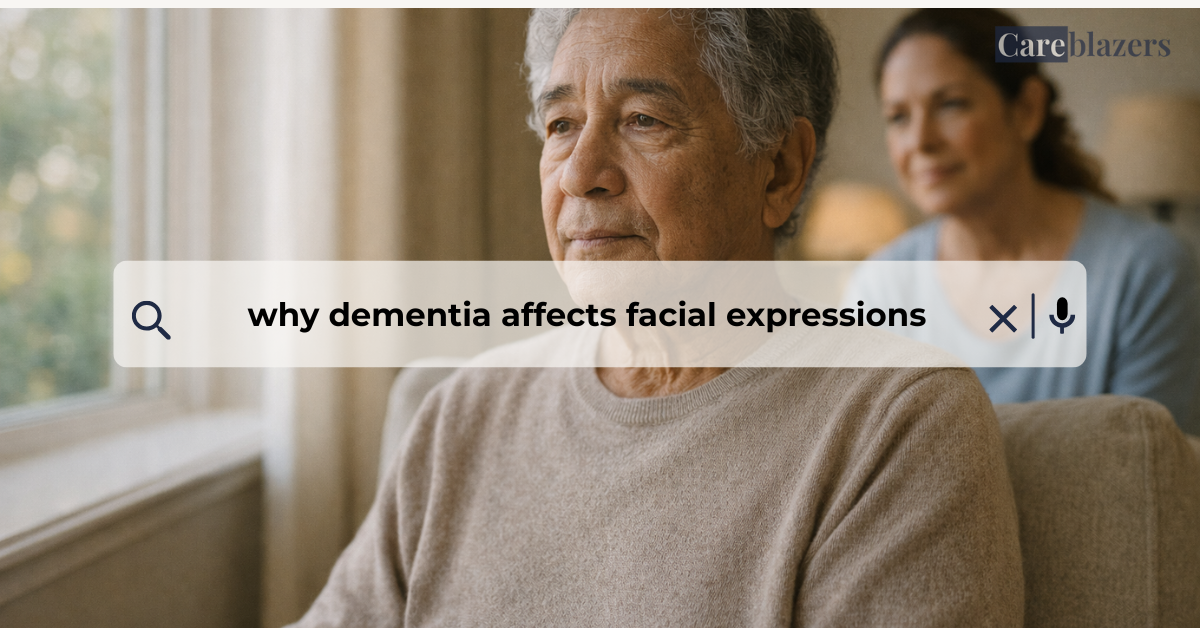
Careblazer, have you ever looked at your loved one and thought something feels different, even if you cannot quite put your finger on it?
Maybe they smile less.
Maybe their face seems flatter or more rigid.
Maybe their reactions feel slower or less expressive than they used to be.
Many caregivers notice these changes long before a formal dementia diagnosis is ever discussed. And for a long time, those observations were hard to explain.
In recent years, researchers have begun to ask a fascinating question. Could subtle changes in facial expression be an early sign of dementia?
The answer is not as simple as looking at someone’s face and making a diagnosis. But emerging research suggests that our faces may reflect early brain changes in ways we are only beginning to understand.
In this article, we will explore what the research is showing, why dementia affects facial expression, and what these changes do and do not mean for caregivers.
Why Researchers Are Studying the Face in Dementia
For a long time, dementia has been framed almost entirely as a memory disease. While memory loss is a core feature, dementia affects far more than memory alone.
Dementia impacts movement, emotional processing, motivation, communication, and how the brain sends signals to the muscles of the face.
Researchers began studying facial expression because the face is controlled by complex brain networks that integrate emotion, motor planning, and social communication. When those networks change, facial expression can change too.
Importantly, these changes are often extremely subtle. They are not the kind of changes most people would notice in a casual conversation.
That is why scientists use advanced software and high-resolution analysis to detect them.
What Studies Have Found About Facial Changes in Dementia
Several studies over the past few years have compared facial movements in adults with dementia to those without dementia.
Researchers analyzed facial micromovements. These are tiny, involuntary movements that occur when we speak, react emotionally, or engage socially.
Here is what they found.
Reduced Facial Expression Variation
People with dementia tend to show less variation in facial expression overall.
This means fewer spontaneous changes in expression, such as smiling, eyebrow movement, or subtle emotional shifts.
Slower Facial Responses
Facial reactions often occur more slowly in people with dementia.
For example, there may be a longer delay between hearing something emotional and showing a facial response.
Smaller and More Rigid Movements
Facial movements may become smaller, more rigid, or less fluid. This is not stiffness from aging alone. It reflects changes in brain-driven motor control.
Fewer Smiles in Early Alzheimer’s Disease
In studies specifically focused on early Alzheimer’s disease, researchers found that individuals smiled less often and showed slower emotional responses, even when they reported feeling emotion internally.
These changes were detected using highly sensitive software. They are not usually obvious to the naked eye, especially in early stages.
Why These Facial Changes Happen
Facial expression is not just about muscles. It is about the brain.
Dementia affects areas of the brain responsible for:
Emotional processing
Motor planning
Social engagement
Facial muscle coordination
When these systems are disrupted, the face may not move or respond the way it once did.
This does not mean the person feels less. It means the brain is having difficulty translating internal emotion into outward expression.
That distinction is incredibly important for caregivers to understand.
What Caregivers Often Notice First
Many caregivers tell me they notice facial changes long before memory problems become obvious.
They may say things like:
They do not smile like they used to.
Their face looks blank sometimes.
They do not react the way they used to emotionally.
These observations are valid. And research is beginning to support what caregivers have noticed all along.
However, it is also important to remember that facial changes alone are not enough to diagnose dementia.
What Facial Changes Do Not Mean
It is essential to clarify what this research does not say.
Facial changes do not mean you can diagnose dementia by looking at someone’s face.
Facial changes do not mean someone is unhappy or emotionally disconnected.
Facial changes do not mean the person does not care.
A flat or reduced facial expression does not reflect what is happening emotionally on the inside.
The brain may still be experiencing emotion, joy, connection, or appreciation. It just may not be able to express it outwardly in the same way.
This is especially important during emotionally meaningful moments like holidays, family gatherings, or celebrations.
Dementia, Emotion, and Misinterpretation
One of the most painful experiences caregivers share is feeling like their loved one is no longer enjoying time together.
They may think:
They do not seem happy to see me.
They are not enjoying this anymore.
They look disengaged.
But research suggests that reduced facial expression is a neurological issue, not an emotional choice.
Your loved one may still feel deeply connected, comforted, or appreciative, even if their face does not show it.
Why Early Detection Research Matters
Researchers are not studying facial expression to create fear or quick diagnoses.
They are studying it because early detection of dementia matters.
The earlier dementia is identified, the earlier families can:
- Access medical care and monitoring
- Plan for the future
- Implement supportive strategies
- Build emotional and practical support systems
Facial expression research is one piece of a much larger puzzle. It may eventually help clinicians identify subtle changes earlier, alongside cognitive testing, imaging, and clinical evaluation.
What Caregivers Can Take Away From This Research
If you have noticed changes in your loved one’s facial expression, you are not imagining things.
It does not automatically mean dementia. But it does mean your observations matter.
Here are a few grounding reminders.
Trust What You Are Seeing
Caregivers are often the first to notice subtle changes.
Avoid Assuming Emotional Meaning
A lack of expression does not equal a lack of feeling.
Focus on Connection, Not Reaction
Connection is not measured by facial response alone.
Seek Evaluation When Patterns Add Up
Facial changes alongside memory, language, behavior, or functional changes deserve medical attention.
Supporting Yourself as a Caregiver
Noticing these changes can be emotionally heavy.
It can feel like you are losing pieces of the person you love, even when they are still physically present.
You do not have to carry that alone.
Learning what is happening in the brain can help reduce self-blame, confusion, and emotional isolation.
A Supportive Reminder for Careblazers
Dementia changes how the brain communicates with the body, including the face.
Your loved one’s reduced expression is not a reflection of your relationship, your care, or their love for you.
It is a reflection of neurological change.
And you are doing the best you can in the middle of something incredibly complex.
Stay Supported and Informed
If you’re looking for weekly support, education, and caregiver-centered guidance, I invite you to subscribe to the Dementia Dose newsletter.
Every week, I share practical insights, research updates, emotional support, and tools designed to help you feel more grounded and less alone on this journey.
You deserve support just as much as the person you are caring for.
Watch On YouTube
Want to watch the in-depth video that inspired this post?
Click the video below to watch. ↓