
What the 2025 NIH Research Progress Report Finally Helps Explain
If you are caring for someone with dementia, you may find yourself asking questions that do not have easy answers.
Why did this happen to my loved one when they were healthy their whole life?
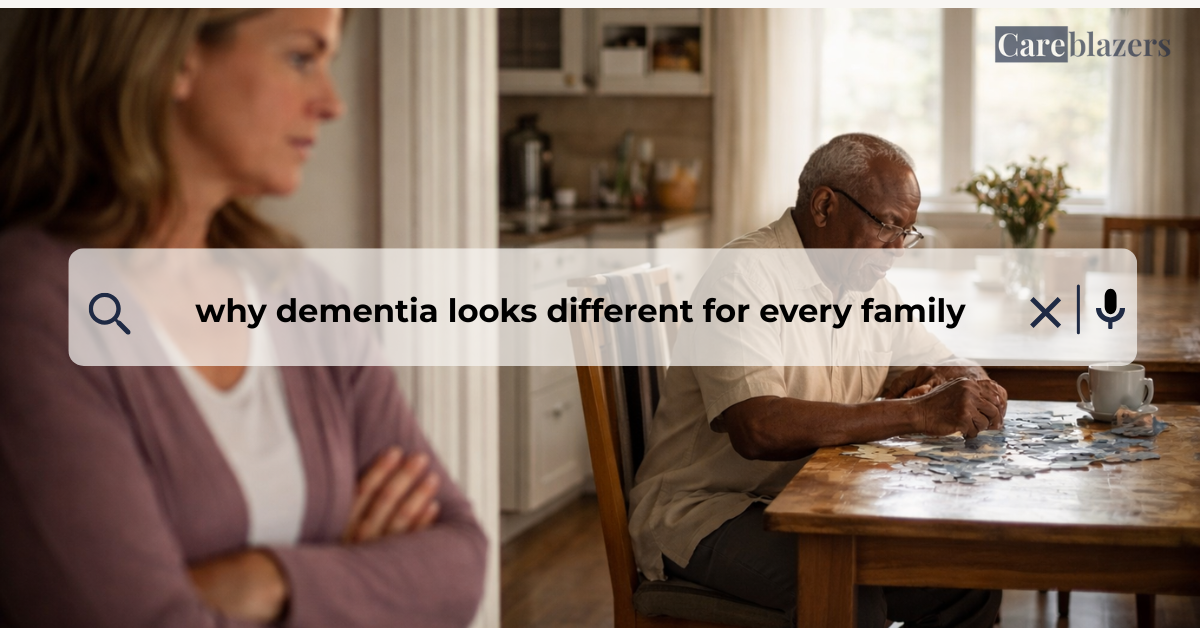
Why does dementia look so different from one person to the next?
Why does caregiving feel so uneven, unpredictable, and overwhelming?
You might know another family whose loved one has the same diagnosis, is the same age, and yet their symptoms, challenges, and daily needs look nothing like yours.
This uncertainty can be deeply unsettling.
The 2025 dementia research progress report from the National Institutes of Health does not offer simple or comforting explanations. But it does offer something more useful: clearer, more honest insight into why dementia varies so widely and why caregiving rarely follows a straight line.
In this article, we will walk through what that report helps us understand, including:
Why dementia risk is not caused by one single factor
What is happening in the brain beyond memory loss
Why symptoms and progression differ so much between people
What new research is revealing about care planning and quality of life
Dementia Risk Is Not One Thing
One of the clearest messages from the NIH progress report is this: dementia risk is not determined by a single cause.
There is no one factor that explains why one person develops dementia and another does not.
Instead, risk is shaped by a combination of influences, including:
Genetics
Chronic health conditions
Environment
Lifestyle habits
Social experiences
Access to healthcare
This matters because many caregivers quietly carry guilt or confusion about why their loved one developed dementia despite “doing everything right.”
The research confirms what many families already sense. Dementia is not a personal failure, and it is not the result of one missed prevention step.
Genetics Matter, but They Do Not Tell the Whole Story
You may have heard about the APOE-4 gene, which is associated with an increased risk of Alzheimer’s disease.
Having one copy of this gene increases risk. Having two copies increases it further. But newer research shows that genetics do not work the same way for everyone.
Researchers are finding that:
Ancestry influences how dementia risk shows up in the brain
Biomarkers developed in mostly white populations may not translate equally across all groups
Some people with high-risk genetic mutations remain cognitively healthy for decades
In one remarkable case described in the research, a man with a strong genetic risk for Alzheimer’s stayed cognitively intact far longer than expected. Researchers discovered that he also carried protective genetic variants related to inflammation and protein regulation.
This tells us something important.
Resilience is not about one protective gene. It is about how many systems in the body interact and compensate for one another over time.
For caregivers, this helps explain why dementia does not follow a predictable or uniform path.
Lifestyle and Social Factors Still Matter, Even After Brain Changes Begin
Another reassuring finding from the report is that lifestyle and social factors remain meaningful even when dementia-related changes are already present in the brain.
Research consistently suggests that people who:
- Engage in regular physical activity
- Eat balanced, nutrient-dense diets
- Avoid smoking and limit alcohol
- Stay socially connected
- Remain cognitively engaged
often maintain better thinking abilities as they age.
One dietary pattern with particularly strong evidence is the MIND diet, which has been linked to slower cognitive decline and reduced dementia risk in several populations.
At the same time, the report highlights risk factors that are often outside an individual’s control, such as:
- Chronic stress
- Food insecurity
- Loneliness
- Exposure to discrimination
These factors increase dementia risk and worsen outcomes.
This matters because it reframes how we think about stress and strain in caregiving.
Caregiver stress is not a weakness. It is a risk factor that deserves recognition, protection, and support.
Taking care of yourself is not just about rest. It is also about brain health.
Why Dementia Risk and Symptoms Differ by Sex
Women make up roughly two-thirds of people living with Alzheimer’s disease in the United States. This difference cannot be explained by longevity alone.
The NIH report highlights meaningful biological differences in how dementia develops across sexes.
Researchers are finding that:
Women may have fewer compensatory brain pathways
Symptoms may emerge more abruptly or progress differently
Women with Lewy body dementia are more likely to also have overlapping Alzheimer’s pathology
These findings are pushing research toward more sex-specific approaches to diagnosis and treatment, rather than assuming dementia behaves the same way in everyone.
For caregivers, this helps explain why symptoms, progression, and caregiving demands can look so different even when diagnoses appear similar.
What Is Actually Happening in the Brain Beyond Memory Loss
For many years, dementia research focused heavily on amyloid and tau proteins. These still matter, but the NIH report makes it clear that they are only part of the story.
Vascular Health Plays a Major Role
Research shows that amyloid disrupts the cells lining blood vessels, interfering with energy production and blood flow.
These changes can appear early, even before visible brain damage is detected.
This helps explain why conditions like high blood pressure, heart disease, and stroke significantly increase dementia risk.
Energy Metabolism Is Emerging as a Key Factor
Researchers are also studying how the brain uses energy.
One molecule, IDO-1, appears to become overactive in Alzheimer’s disease. When this happens, support cells in the brain struggle to deliver fuel to neurons.
In research models, blocking this pathway allows those support cells to function more normally, making it a promising area for future treatment development.
Dementia Is Likely Multiple Overlapping Diseases
Beyond amyloid and tau, researchers are identifying other proteins, such as TDP-43, that begin misbehaving years before symptoms appear.
This reinforces a critical shift in thinking.
What we currently call Alzheimer’s disease is likely not one disease, but several overlapping processes happening at once.
This is why personalized and precision-based approaches are becoming so important.
What Research Is Revealing About Care Planning
The NIH progress report did not focus only on biology. It also examined care quality, planning, and difficult decision-making.
Researchers are developing predictive models that use factors like:
- Age
- Daily functioning
- Driving ability
- Fall history
These tools aim to help families anticipate when long-term care support may be needed, ideally before a crisis occurs.
They are not perfect, but they represent a shift toward earlier, more proactive planning.
Staffing Alone Is Not Enough in Dementia Care Settings
Studies of nursing homes show that increasing staffing improves some outcomes, but staffing alone does not guarantee better care.
Facilities with higher dementia populations often rely more heavily on medications to manage behaviors and see greater declines in daily functioning.
At the same time, they may have fewer pressure injuries and fewer emergency room visits.
This tells us something important.
Specialized dementia training, particularly around how to respond to behaviors, is just as critical as staffing numbers.
Honest Conversations About Quality of Life Matter
The report also highlights how costly dementia care can be, without always delivering better outcomes.
NIH-funded studies examining long-term acute care hospitals found that many adults over 50 experience poor outcomes or death within a few years. Outcomes are worse when dementia is present.
This does not mean families should never choose these settings.
But it does underscore the importance of honest conversations about:
- Goals of care
- Quality of life
- Palliative care options
What improvement realistically looks like
Better care decisions begin with clear information, not fear or urgency.
Moments of Lucidity in Advanced Dementia
One of the most emotionally powerful sections of the report focuses on lucidity.
Researchers have documented brief moments when people with advanced dementia suddenly become more aware, communicative, or emotionally connected.
These moments are often short, but they deeply affect the family members who witness them.
Interestingly, most of these lucid episodes occur during family visits.
This suggests that connection and environment play a meaningful role, even late in the disease.
The takeaway is not false hope. It is something quieter and more grounding.
Even in advanced dementia, there is more happening in the brain than we can easily see.
What This Research Means for Caregivers
When you step back, the message from the 2025 NIH progress report is both complex and reassuring.
Dementia is not caused by one factor.
It does not follow one path.
It does not look the same for every family.
Biology matters. Environment matters. Care matters.
And research is finally catching up to what caregivers have known all along. Planning, quality of life, and caregiver support are not side issues. They are central to good dementia care.
You Do Not Have to Make Sense of This Alone
The science of dementia is advancing, but translating that information into day-to-day caregiving decisions is still incredibly hard.
If you are looking for personalized guidance, real-world strategies, and ongoing support as behaviors change and evolve, the Care Collective exists for that exact reason.
Its a place where caregivers receive help not just understanding dementia, but knowing what to do next, with clarity, compassion, and support. You can click here to learn more.
You are not behind. You are navigating something complex.
And you deserve guidance that reflects that reality.
If you missed Part 1 of this research breakdown, where I cover early detection, treatment advances, and precision medicine, you can read it here.
Frequently Asked Questions
Why does dementia look so different from person to person?
Research suggests dementia involves multiple overlapping biological processes, influenced by genetics, vascular health, environment, and life experiences. No two brains are affected in exactly the same way.
Can lifestyle still help after dementia begins?
Yes. Studies suggest that physical activity, nutrition, social connection, and cognitive engagement may still support brain function and quality of life, even after changes are present.
Why do symptoms sometimes appear suddenly?
Differences in brain compensation, sex-related biology, and overlapping disease processes may cause symptoms to emerge more abruptly in some people than others.
Are moments of lucidity common?
They are not constant, but they are documented. These moments often occur during meaningful connection and can be emotionally significant for families.
Watch On YouTube
Want to watch the in-depth video that inspired this post?
Click the video below to watch. ↓