
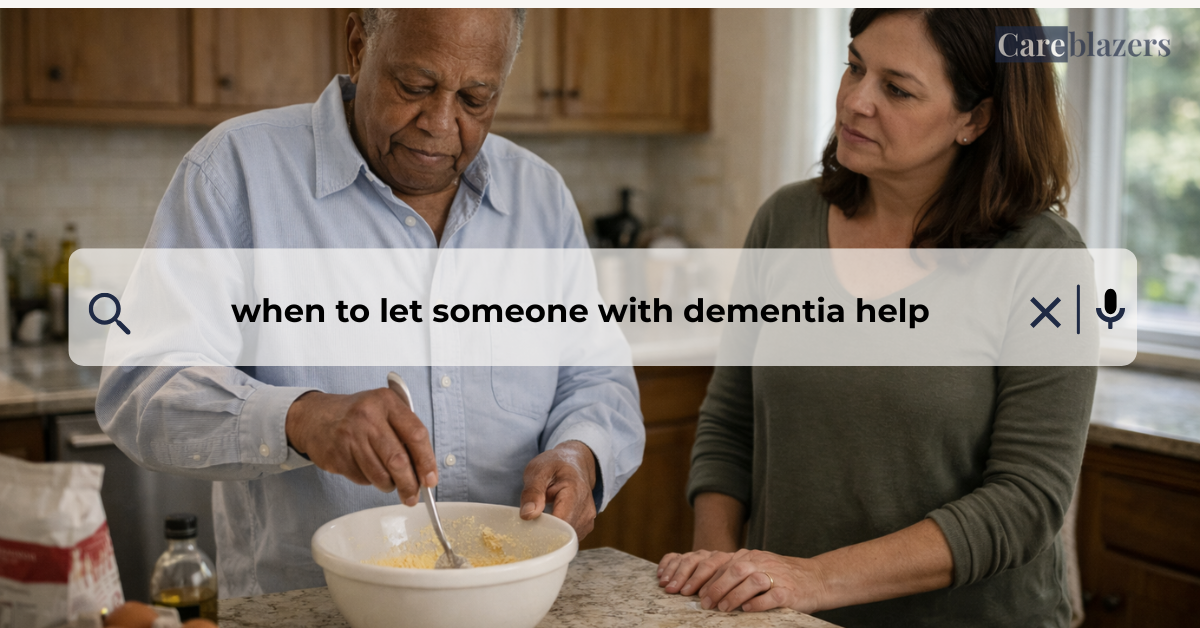
You’ve been told to keep your loved one with dementia engaged.
Let them help. Encourage independence. Include them in daily tasks. Help them feel useful.
And you want to do that.
But when you try, everything takes longer.
It gets messier. You fall behind. You repeat instructions five times. You fix what was done incorrectly. You end up more exhausted than before.
And somewhere inside, frustration starts to build.
Then the guilt follows.
If you’ve ever wondered:
When should I let someone with dementia help?
Is it wrong to just do it myself?
Am I hurting them by not including them?
Why does this feel so hard?
This article is for you.
Because the advice to “keep them engaged” is not wrong.
It is incomplete.
The Invisible Load Caregivers Carry
Most advice about engaging someone with dementia focuses on the person with dementia.
What often gets left out is the invisible load the caregiver carries.
The time pressure. The mental cleanup. The emotional regulation required to stay patient. The domino effect when things run late.
When someone with dementia helps with a task, it is not just a slower version of the same task.
It is often:
One step at a time instructions
Repeating prompts
Monitoring for safety
Fixing errors
Managing your own rising frustration
And on top of that, many caregivers feel pressure to remain endlessly patient, grateful, and kind.
When you don’t feel that way, it can feel like you’ve failed.
You haven’t.
You’re human.
Why Helping Takes So Much More Effort in Dementia
When someone with dementia wants to help, the effort required is often invisible.
Processing speed slows in the brain. Tasks that once took seconds now take minutes.
The ability to hold multiple steps in mind declines. Instructions need to be broken down.
Error awareness often fades. Mistakes happen without recognition.
What looks like “helping” is actually:
A high cognitive load for them
A high emotional load for you
So the real question becomes:
When is it helpful to let them help? And when is it okay not to?
The Two Buckets That Change Everything
Here’s where clarity begins.
Not all tasks are equal.
There are two buckets.
Bucket 1: Outcome-Dependent Tasks
These are tasks where the outcome truly matters.
If the task is not done correctly, there are consequences.
Examples:
Filling a pill box correctly
Managing medications
Getting ready for a time-sensitive appointment
Paying bills
Cooking safely
If something goes wrong, it creates stress, safety risks, or a cascading delay in your day.
In these tasks, the end result matters.
Bucket 2: Outcome-Neutral Tasks
These are tasks where the process matters more than the result.
Examples:
Folding towels
Sorting socks
Wiping down a counter
Stirring ingredients
Organizing papers
If it’s done incorrectly, nothing significant happens.
No safety issue. No major domino effect. No irreversible consequence.
This distinction is everything.
Engagement Is About Process, Not Perfection
When someone with dementia participates in outcome-neutral tasks, the value is not in the final result.
The value is:
Inclusion
Contribution
Purpose
Connection
The towels do not need to be perfectly folded.
The counter does not need to be spotless.
If you are choosing engagement tasks, choose tasks where the process matters more than the outcome.
Let them do it imperfectly.
Let it take longer.
Let it be messy.
Because in those moments, the goal is not efficiency.
It is dignity.
When It’s Okay to Just Do It Yourself
Here is the part caregivers rarely hear clearly enough.
It is okay not to include them in everything.
If the task is outcome-dependent and:
You are exhausted
You are running late
You do not have the emotional capacity
The stakes are high
You are allowed to do it yourself.
That is not dismissive. That is not unkind. That is not giving up on their independence.
It is protecting both of you from unnecessary stress.
You can say:
“I’m going to take care of this right now. You can help me later.”
Or:
“I could really use your help with this instead.”
Redirect to something outcome-neutral.
That is intentional caregiving.
The Myth of Being Consistent All the Time
Many caregivers get stuck here.
You let them help one day when you had energy.
The next day, you don’t.
And then guilt creeps in.
“I should be consistent.”
But consistent does not mean identical.
Your capacity changes. Your patience changes. Your stress level changes. Their behavior changes.
Caregiving is not static.
Your decisions are allowed to change too.
The Filter That Makes This Easier
Before deciding whether to let your loved one help, ask yourself two questions:
Does the outcome matter?
What do I have capacity for today?
If the outcome matters and your capacity is low, take it on yourself.
If the outcome does not matter and you have the space, invite participation.
This is the messy middle of dementia caregiving.
Not all-or-nothing. Not right-or-wrong.
But flexible.
Why This Matters for Burnout
When caregivers try to follow rigid rules without considering their own capacity, burnout builds.
When you feel obligated to include your loved one in every task, even when you are exhausted, resentment builds.
Sustainable caregiving requires flexibility.
It requires permission to protect your time and energy.
Because if you burn out, no one wins.
You Are Allowed to Choose Help That Helps
You are allowed to protect your schedule.
You are allowed to move quickly when needed.
You are allowed to choose tasks where engagement makes sense.
You are allowed to change your approach based on the day.
That is not inconsistent.
That is responsive.
That is intentional caregiving.
Sustainable Caregiving Lives in the Messy Middle
Books and videos can offer best practices. But they cannot see your real life.
They cannot see:
The appointment you’re late for
The night you didn’t sleep
The behavior flare-up that morning
The mental load you’re carrying
Sustainable dementia caregiving happens in the gray space.
Where you apply principles thoughtfully.
Where you make decisions based on reality, not guilt.
Where you stop judging yourself against advice that does not know your circumstances.
That is the real work.
Want Help Navigating the Messy Middle?
If this conversation resonated with you — if you are tired of feeling stuck between “what I’m supposed to do” and what actually works in real life — I’m hosting a live Behavior Breakthroughs class in March.
In this training, we will cover:
The most common causes behind dementia-related behaviors
Why certain “best practices” feel impossible some days
How to respond in ways that are realistic, sustainable, and grounded in how the brain actually works
This is not about doing more. It’s about responding differently.
It’s about learning how to operate in that gray area — the messy middle — without guilt and without burning yourself out.
Watch On YouTube
Want to watch the in-depth video that inspired this post?
Click the video below to watch. ↓