
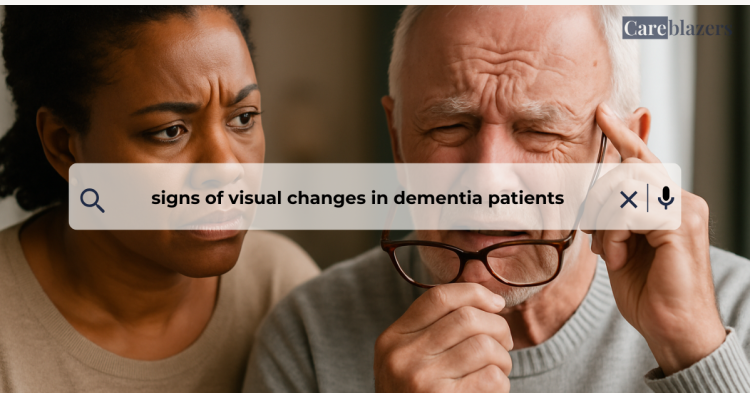
When we think about dementia, our minds usually go straight to memory loss, confusion, or changes in behavior. But dementia affects far more than memory. It changes how a person sees, interprets, and understands the world around them.
This is why many caregivers tell me:
“My loved one just had an eye exam and everything was fine, but they are still having vision problems.”
If this sounds familiar, you are not alone.
In dementia, the eyes may be healthy, but the brain’s ability to process visual information becomes damaged, creating a wide range of visual difficulties that can be confusing, frightening, and sometimes dangerous.
In this guide, I will walk you through:
The most common vision changes in dementia
Some lesser-known but important visual symptoms
How these differ from normal aging
What you can do to make life safer and easier for your loved one
My goal is to help you understand what is happening and give you clear, practical steps you can start using today.
Understanding Vision Changes in Dementia
Vision changes in dementia are rooted in the brain, not the eyes. Even with perfect vision, people with dementia may misinterpret, misunderstand, or be unable to recognize what they see.
Below are the most common visual difficulties caregivers notice.
Decreased Visual Field (Tunnel Vision)
One of the earliest and most common visual changes in dementia is a narrowed visual field, often called tunnel vision. It means your loved one sees only what is directly in front of them, missing anything off to the side.
How this may show up:
- Bumping into furniture or door frames
- Missing food on the sides of their plate
- Being startled when someone approaches from the side
- Saying “Who keeps moving my things?” because they cannot see objects unless they are directly in front of them
This is not typical aging.
In dementia, the visual field can shrink dramatically, leaving your loved one with a very limited view of the world.
Difficulty With Depth Perception
Depth perception allows us to judge the distance, height, and position of objects. Dementia damages spatial processing regions in the brain, making it harder to accurately understand depth.
What you might notice:
Hesitating at stairs
Reaching for a cup and missing
Pouring coffee and spilling everywhere
Thinking a flat floor is uneven
Mistaking shadows for objects
While depth perception can decline slightly with age, the confusion, hesitation, and misjudging you see in dementia are far more significant.
Problems With Color and Contrast Sensitivity
Even with healthy eyes, the brain may lose its ability to distinguish colors or see contrast clearly.
Real-world examples:
A white plate on a white tablecloth disappears
A dark mat looks like a hole in the floor
The toilet seat becomes hard to find
Food blends into the plate
This is why brightly colored dishes, linens, and toilet seats can make such a big difference. They stand out clearly, reducing confusion and preventing missteps.
Visual Agnosia (Difficulty Recognizing Objects or Faces)
Visual agnosia is not a vision problem. It is a recognition problem.
Your loved one can see the object but cannot identify what it is.
Examples:
- Looking at a fork but not recognizing it
- Seeing a pen but trying to use it as a toothbrush
- Not recognizing their own reflection
- Staring blankly at a familiar person
In normal aging, we may take longer to name something.
In dementia, the brain fails to connect what is seen with what it means.
This can affect safety, daily tasks, and social interactions.
Less Common Visual Changes in Dementia
In addition to the more familiar symptoms, some people experience more complex visual disturbances.
Visual Hallucinations
Visual hallucinations are most common in Lewy body dementia and Parkinson’s disease dementia, but they can appear in other types as well.
Your loved one may see:
Animals in the room
People who are not there
Bugs on their body
Objects shifting or moving
Importantly, these are not imagination or stubbornness.
Their brain is showing them something very real to them.
Correcting or arguing only increases fear and frustration.
Validation and reassurance are far more helpful.
Motion Blindness
Some people lose the ability to detect motion. This is rare but dangerous.
What it looks like:
Cars look like they are standing still
A moving object seems frozen
Difficulty crossing streets
Sudden loss of safe driving ability
Normal aging may slow motion detection slightly, but dementia can impair it entirely.
Simultanagnosia (Seeing One Thing at a Time)
This condition limits the brain to seeing only a single part of a visual scene.
For example:
Seeing the dinner plate but not the utensils
Not noticing the people around them
Missing half of what is on the table
Becoming overwhelmed by visually busy spaces
Normal aging slows scanning, but does not prevent us from taking in an entire scene.
With simultanagnosia, the brain literally cannot process it.
Why New Glasses Don’t Fix the Problem
You may have experienced this frustrating cycle:
Your loved one struggles with vision
You take them to the eye doctor
The exam says everything looks fine
Their vision difficulties continue or worsen
That is because the problem is not the eyes.
It is the brain’s image-processing system.
Glasses can correct the lens.
But they cannot correct damaged cortical pathways.
What Caregivers Can Do to Help
While you cannot restore lost visual processing, you can dramatically improve safety, comfort, and confidence.
Here are the most helpful strategies.
1. Increase Contrast
Choose items that stand out clearly.
Bright plates for meals
Dark placemats under light dishes
Colored tape around doorframes
A bold toilet seat cover
Contrasting bedding
High-contrast clothing choices
Contrast helps the brain focus on what matters.
2. Simplify the Environment
Reduce visual clutter as much as possible.
Clear off countertops
Remove unnecessary decorations
Keep commonly used items in the same spots
Use trays to group items together
A simpler visual space reduces confusion and frustration.
3. Improve Lighting
Dim areas and shadows can be misinterpreted as holes, objects, or people.
Use bright, even lighting
Add nightlights in hallways and bathrooms
Avoid strong shadows
Open curtains during the day
Good lighting helps prevent falls and reduces visual misinterpretation.
4. Label and Organize
Use clear, simple labels for:
Drawers
Cabinets
Closets
Bathroom items
Labels give visual anchors and reduce the cognitive load of searching.
5. Honor Their Visual Experience
Remember, your loved one may truly see:
A hole in the floor
A dog on the bed
A stranger in the mirror
Avoid saying “That is not there.”
Instead try:
“I can see that looks scary. You are safe. I am right here with you.”
Validation eases fear and maintains trust.
Normal Aging vs. Dementia: Key Differences
Normal Aging
|
Dementia
|
Vision prescription changes
|
Brain misinterprets what the eyes see
|
Slight loss of color sensitivity
|
Colors and contrast blend together
|
Slower depth perception
|
Severe depth confusion and missed objects
|
Slower recognition of objects
|
Unable to recognize familiar faces or items
|
Occasional misinterpretation
|
Full hallucinations or visual distortions
|
Understanding these differences helps you approach your loved one with more clarity, patience, and compassion.
Supporting a Loved One Through Visual Changes
The visual world of a person with dementia can quickly become confusing or frightening. Their reactions may not always make sense to us, but they make perfect sense through the lens of their changing brain.
With the right understanding and small environmental changes, you can help reduce fear, prevent falls, and make day-to-day life more manageable and dignified.
And you do not have to navigate this alone.
If you would like ongoing guidance, weekly support, and a community that truly understands the journey you are on, I invite you to subscribe to The Dementia Dose. It is my free weekly newsletter where I share practical tips, emotional support, and clear guidance to help you feel more confident in your caregiving.
Watch On YouTube
Want to watch the in-depth video that inspired this post?
Click the video below to watch. ↓