
They refuse to shower. Again.
You’ve explained, begged, pleaded. Still nothing.
Sound familiar?
It’s frustrating. You’re trying your best. And yet, the more you try, the more upset everyone gets. If you’ve been there, you’re not alone. But what if the problem isn’t your loved one at all?
What if it’s the way we’re seeing the problem?
Today, we’re going to talk about the #1 mistake caregivers make when dealing with dementia behaviors and how shifting your perspective could unlock the results you’ve been desperately trying to find.
Why “How Do I Get Them To…?” Is the Wrong Starting Point
Let’s start with a question you’ve probably asked before:
“How do I get my loved one to take a shower?”
“How do I get them to stop driving?”
“How do I get them to accept help?”
These questions seem harmless, even logical. But here’s the problem:
They keep you focused on trying to change the person, instead of understanding the behavior.
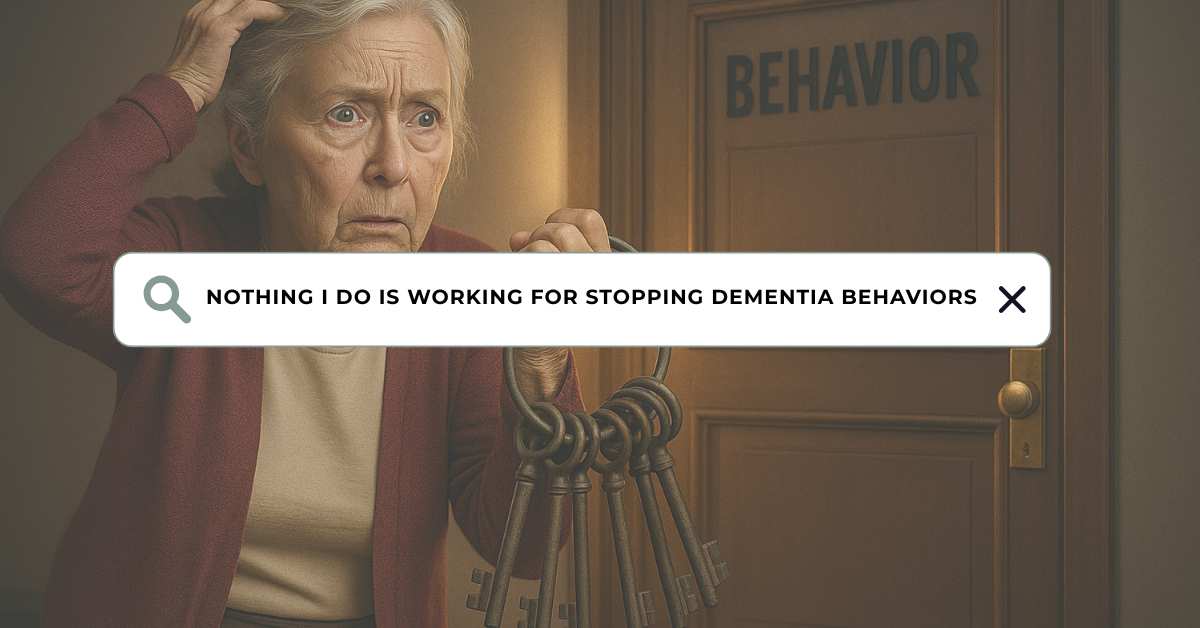
That’s like trying the same key in a locked door over and over, hoping it’ll finally turn. Spoiler: it won’t.
If we want better results, we need a different key.
Think of Every Behavior Like a Locked Door
Imagine standing in front of a locked door.
You pull out your key and try it—but it doesn’t work. Does that mean the door can’t be opened? No. It just means you’re using the wrong key.
This is exactly how dementia behaviors work.
The behavior (e.g., not showering) is the door
Your approach is the key
If it’s not working, you need a new key—not a new door
And just like every door in your neighborhood has its own unique lock, each behavior, person, and moment requires a different key.
Not Wanting to Shower? It Could Be 10 Different “Locks”
Let’s use the showering example:
Why might a person with dementia resist bathing? The reasons are endless:
The water feels painful on their skin → Sensory/pain lock
They don’t understand what’s happening → Confusion lock
They’re afraid of falling → Fear lock
They don’t trust the caregiver → Relationship lock
They think they already showered → Memory lock
They feel embarrassed or modest → Emotional lock
They’re tired or overstimulated → Energy/stress lock
Each of these scenarios would need a different approach, a different key.
So instead of asking, “How do I make them shower?” ask:
👉 “What might be making this hard for them?”
Same Behavior ≠ Same Solution
Here’s the trap: you see one behavior—like refusing a shower—and assume the same solution will work for everyone.
But even if the behavior looks the same, the reason behind it could be totally different.
“You’re not going to use the same key for every door—even if all the doors look alike.”
That’s why one caregiver’s approach might work wonders while yours leads to more resistance. You’re not wrong—you’re just using the wrong key for your situation.
The Mindset Shift: Stop Assuming, Start Assessing
Here’s the most important takeaway:
Stop assuming.
Start assessing.
The moment you say:
“They’re just being stubborn…”
“They’re lazy…”
“They never want to cooperate…”
…you’re locking the door tighter. You’re moving farther away from the key.
Instead, shift to:
“What might they be communicating”
“What could be causing this reaction?”
“What have I tried, and what’s worth trying differently?”
That’s how you start narrowing down your big, messy key ring to just a few promising ones.
Logic Over Emotion: A Better Way to Understand Behavior
It’s easy to get emotional. You care deeply, and this is personal. But logic helps us find solutions faster.
Here’s the difference:
| Emotional Thinking | Logical Thinking |
|---|---|
| “They’re just lazy.” | “Maybe they think they already showered.” |
| “They’re always difficult.” | “They might be embarrassed about being seen naked.” |
| “They’re trying to annoy me.” | “They could be overwhelmed or overstimulated.” |
Every emotional assumption creates a wall. Every logical question builds a bridge.
So, What Do You Do Next?
The first step is to stay curious. Start looking at behaviors through a new lens.
Here are some practical questions you can ask yourself the next time something challenging happens:
What exactly is my loved one saying or doing?
What time of day is this happening?
What’s their physical and emotional state?
What was happening right before the behavior started?
What might they be trying to express without words?
This process of gentle curiosity over judgment brings you closer to solutions—faster and with less stress.
Join My 5-Day “Behavior Breakthrough” Live Experience
If this feels overwhelming—like too many keys, too many unknowns—you don’t have to do it alone.
Join the 5-day live experience: Behavior Breakthroughs, where we walk through:
The exact steps to identify the behavior “locks”
How to narrow your keys down to just a few effective approaches
This isn’t just theory—it’s real strategies for real caregivers who want to reduce frustration, deepen connection, and feel more confident in what to do next.
It’s Not About Changing Them. It’s About Changing Our Approach.
You love them. That’s why you’re here.
The mistake most caregivers make isn’t about not trying hard enough. It’s about trying too hard in the same direction—without realizing the door needs a different key.
You’ve got this, Careblazer. And if you ever feel like you don’t, we’re here to help.
Want to watch the in-depth video that inspired this post?
Click the video below to watch. ↓